By Yusuff Uthman Adekola
humanity is a phenomenon hinged on shared existence, slung like a bag around the firm shoulders of responsibility, of trust, of love, of compassion and of honour.
The first time I would open my eyes, let out a cry of life and be called a human, I did not do it alone. There were other humans around me: first, my mother, half-dead in the throes of coma after a caesarean; then the doctors and nurses, with their anxiety gently thawing; and my father, somewhere not too far from the operating theatre, his mind shaking, certainly, with uncertainty, and his lips leaking with prayers.
There were others, too, whose physical bodies might not be there at the hospital, but whose minds, well wishes and concerns, must have roamed around as phantoms of nervousness: family, relatives, friends, acquaintances and neighbours, plus some others who must have thrown one or two words of prayer upon simply knowing someone was going to give birth.
The period after my birth also came with its slice of rallying, as I still was not alone, and neither were my mother and my father, as there was my grandmother there to help my recuperating mother. There also came greetings here and there, visitations from far and wide, gifts around and everywhere, felicitations, congratulations, and then the naming ceremony that would finally bring everyone together under the pitched tent of celebration.
And as is the case with naming ceremonies in our culture, many people were around, smiling, praying, spending and spraying money with joy, eating and drinking as they liked, meeting other people and chatting with friends and family they had not seen for long. Of course, it did not really matter your relationship with whoever was doing the ceremony or who came; everyone present was meant to be a brimming tumbler, a river in full spate, filled with joy. After all, it was, and this is, Africa, and the spirit is supposed to be selfless and communal.
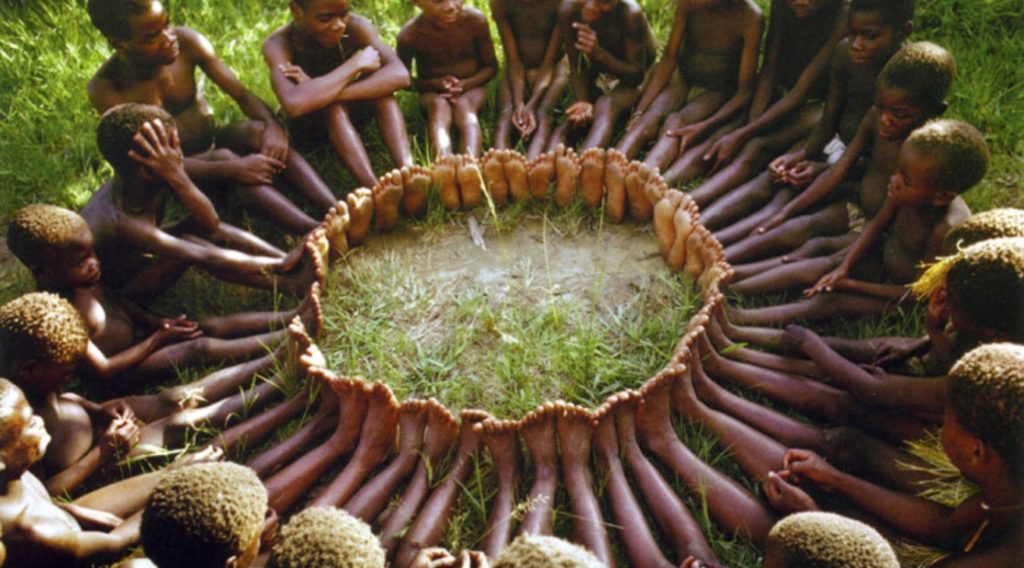
Talking of the spirit of selflessness and communal existence, there comes to mind the popular African philosophy of Ubuntu known to have originated from the Southern African languages of Zulu and Xhosa. Ubuntu has been translated as ‘I am, because you/we are’ and understood to mean that ‘a person is a person through other persons’. What this connotes, in other words, is that humanity is a phenomenon hinged on shared existence, slung like a bag around the firm shoulders of responsibility, of trust, of love, of compassion and of honour.
As such, it holds true that a human is truly human only through his/her display of humanity towards others. Obviously, that was what everyone who had tended to my birth in their unique ways had shown: their humanity; that ‘I’ was another human ushered to the world, because ‘they’ were my precursors ready to welcome me with a shower of confetti that was their heartiness, their love, their care.
This technically comes as a pure opposite to René Descartes’s individualistic, self-centric ‘cogito, ergo sum’ meaning ‘I think, therefore I am’, which suggests that the human existence is no other than a matter of the self, a matter of personal thoughts and doings alone. Had the people followed this philosophy of Descartes’s, my birth would not have been greeted with such collective enthusiasm and show of care. Thus, Ubuntu is further affirmed as a consideration of the self in relation to others, the reality of being human only through being humane to others.
Interestingly, in many different ways, the world has acknowledged the ubiquitous significance of the statement ‘I am, because you are’. One of such acknowledgments is the technological description of the world as a global village, denoting that humanity is a single community bound by mutual interactions. In the same vein, we find that the Danish people for instance are known to maintain a harmonious societal foundation based on trust, where one Dane presumes the other to be trustworthy, and this, one can convincingly say, has proven to be a reason why Denmark remains at the top of the world’s least corrupt societies. In the Yoruba philosophy as well, every human is seen as an inevitable support system to the other; and so they would say ‘ènìyàn laṣọọ̀ mi’ roughly translated as ‘humanity is my cloth’; so, on various attestable fronts, the Yoruba people are arguably known for hospitality.
To bring things into better perspective, the ongoing COVID-19 pandemic has exemplified a focal point for what it means for anyone to say and mean to say ‘I am, because you are’. Just as the virus is blind to boundary, skin, tongue or class, and is currently the cause of over 800,000 deaths worldwide, different nations of the world, organisations and individuals have continued to provide humanitarian supports in cash and kind. The foremost in this case are the healthcare workers who are at the very front line of the battle as though they are immune to contracting the virus or probably are themselves the vaccine to treat it.
Sadly, according to a report by Aljazeera (July 13, 2020), Amnesty International has noted that over 3,000 health workers have said hello to the ghosts, in the wake of their response to the pandemic. In spite of this fact, and even coupled with the unfavourable working conditions experienced by many of them, these people remain true to their humanitarian calling, unabashed as they wear humanity still as their clothes, further pronouncing through their actions the principle of Ubuntu, that they are because we all are and we all are because they are. Even more so, recent economic realities across the globe have come with harsh frowns, as the International Momentary Fund (IMF) in fact submits that countries of the world have spent an estimated total amount of money rising above $9 trillion in response to the corona virus crisis.
All of this goes to show that while the world continues to ail, the denizens of it have found succour in hailing their intrinsically human interconnectedness. The virus reminds us all that indeed an injury to one of us is an injury to all of us, and that taking care of oneself is taking care of others, and vice versa. In relation to this, good public health becomes ensured through personal well-being informed by collective consciousness, as everyone follows the necessary guidelines towards reducing the spread of the virus; everyone therefore simply enacts the values of Ubuntu which says ‘I am, because we are’, since every person’s safety or unsafety from the virus is dependent on another’s infection by it.
Indeed, there is no doubting the truth in John Donne’s musing, when he says in a poem of his that ‘No man is an island entire of itself; every man is a piece of the continent, a part of the main…’ Perhaps it gets even more cogent to add that: no man is a high lord all by himself except that every other man helps to hold him high.
Definitely, this piece of writing itself is, only because the readers are; therefore, Ubuntu remains a compass that is all-encompassing for all.
Yusuff Uthman Adekola is a Nigerian poet.
![BEFORE YOU SAY NO… [or: I AM RIGHT; YOU ARE WRONG]](https://tobiidowu.com/wp-content/uploads/2021/10/tope-lanre-bello.jpeg?w=1024)
 Tobi Idowu