Category: Reviews

  • Teaching Oleku: Tunde Kelani’s Yoruba Classic for a New Generation

    Teaching Oleku: Tunde Kelani’s Yoruba Classic for a New Generation

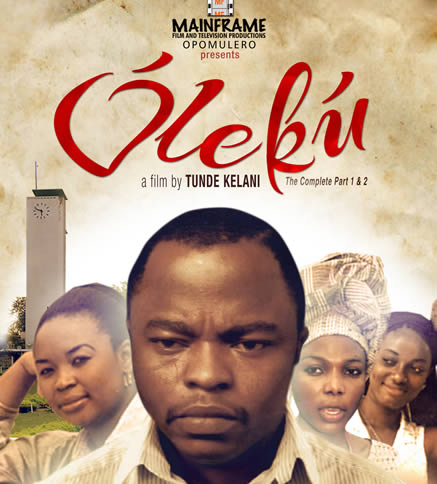
    When I started teaching this eight-week Yoruba class, I had modest expectations about the enthusiasm of my would-be students. They have, however, surprised me with their earnest curiosity as they have questioned, troubled, and teased out deeper meanings of the cultural texts I’ve put before them. As the class is ending next week, I’ve begun to reflect on the works we used in class. One of them is Tunde Kelani’s Oleku (1997), a film I first saw years ago and have now revisited through the inquisitive eyes of my students.

    My students are Americans, as I’m teaching in the United States, and about 90 percent of them are what language scholars call “heritage learners.” Their parents are native speakers of Yoruba, the language of the films we’ve been watching, so most of them already speak Yoruba at an intermediate to advanced level. Another detail worth noting before I get into Oleku is that the majority of my students were born at least five years after the film’s release.

    I’m not setting out to write a film review in the strict sense. What I want to share here are some quick reflections enriched by the experience of rewatching Oleku alongside students who are at least a decade younger than me, and with whom I share both a cultural bridge and a generational gap.

    My students loved, and were intrigued by, the story of Ajani (portrayed by Yemi Shodimu) and his triangular love entanglements with Asake (Feyikemi Abodunrin), Lola (Pauline Dike), and Sade (Omolola Amusan). They could relate to the steamy college romance theme, as it mirrors experiences they might be living through themselves. But they were especially struck by the weight of family expectations on Ajani, pressures that shape, and sometimes constrain, his choices. Beyond his apparent philandering, Ajani carries the heavy burden of a mother who constantly urges him to marry so she can become a grandmother and deliver that good tidings to his late father when she, too, joins the ancestors.

    Then there’s Asake’s father (Lere Paimo), who is a man whose rigid parenting is ironically tied to his embrace of modernity. He wants his daughter to attend university, which, in the 1960s postcolonial setting of the film, was seen as the ultimate pathway to producing “modern” citizens. Yet, while pushing her into the machinery of modernity, he clings to traditional fatherly authority, where his word is absolute.

    “I want her to graduate with my name on her certificate,” he tells his friend (Kola Oyewo). He refuses to accept the possibility, which is presented by his friend, that a married woman could still graduate under her maiden name. His stance is a reflection of what can be described as provincial modernity that has persisted across Africa: the inability to reconcile the ideals of progress with the weight of tradition. Like Asake, many citizens find themselves stuck in the crosshairs of this unresolved dilemma.

    Rewatching Oleku this time made me realize something I hadn’t fully appreciated before. It is as much Asake’s story as it is Ajani’s, even though for nearly three decades Ajani has been the major point of discussion.

    After we finished the film, I asked my students for their final thoughts. While they enjoyed the story, they noted two things. First, the casting: the characters looked older than typical college (or university, as we say in Nigeria) students. I agreed that their observation holds true for American campuses today, and mostly even for present-day Nigerian campuses. But that, in 1960s Nigeria, it wasn’t unusual for students to be considerably older.

    Their second observation was harder to dispute: the pacing felt slow. On that point, I had no defense.

  • Book Review: Kike Ojo’s Fire in the Wind — When Is Success Enough in a Jaundiced Society?

    Book Review: Kike Ojo’s Fire in the Wind — When Is Success Enough in a Jaundiced Society?

    Literary works are often expected to reflect the societies of their provenance. This expectation is particularly strongly held on to by a lot of African critics and even authors, who more often hinge the relevance of a literary work on the subject that preoccupies it.

    Over the years, however, what constitutes issues to be reflected have become rightly more varied and gone beyond writing back to the empire or responding often in angst to the agonizingly undesirable state of post-independence African countries.

    Attention, for instance, has shifted to micro-relationships – altruistic or sinister – within the society and the ramifications of such relationships for the individual as well as the society. It is in this light that Kike Ojo’s novel, Fire in the Wind, published by Kraft Books, draws its thematic inspiration – and relevance – as the story of Angela, the protagonist, unfolds.

    A complexly woven narrative, which straddles three West-African countries and goes back and forth between the present and the past, Fire in the Wind narrates Angela’s moving struggle against the overwhelming tide of an unfair fate, aided by a partial society. A product of an illicit affair between a married headmaster and an economically disadvantaged, out of school 16-year-old girl in a backwater village in Sierra Leone, Angela is set for an uncertain life, which will be pockmarked by unceasing misfortunes.

    Her hard fate appears sealed quickly as she is soon orphaned and later impregnated at 14. Remarkably, Angela, through sheer determination, pulls herself out of the morass of her life’s misfortunes to become a university don in Nigeria.

    Her struggles do not end there.

    As movingly narrated by the author, Angela’s personal achievements do not matter in a highly prejudicial society. She soon finds out that she has less stakes in her immediate family once the extended family members are much in the frame. That she gives birth to two daughters – not boys – in succession makes her stakes reduce further. By the time she has the presumably marriage-saving boy-child, Angela’s patience for patriarchal shenanigans has worn out beyond repair. And she consequently seeks succour in Ivory Coast.

    Her struggles do not end there, too.

    She has got to contend with the frightening ghost of her early years in Sierra Leone. The hurts and agonies since repressed and forgotten begin to find expression in terrifying dreams. Not until she confronts and resolves the events – and their consequences – will she be able to find solace she desperately seeks. Importantly, her recourse to faith, which is a much foregrounded theme in the story, is definitive in her longing for resolution, and the novel’s espousal of the ultimate triumph of good over evil.

    It is testament to the brilliance and maturity of the authors artistic craft that she largely succeeded in unifying the various elements of setting and plot events that make up the narrative. While the novel is lean pagewise – 217 pages – the events of the story and the settings they play out in are relatively quite significant.

    A sloppy or inexperienced writer would possibly have lost track of and be lost in the seemingly rapidly narrated successive events that almost always appear in few pages gap within the story. And to think those events flip back and forth across time and geographical locations… Ojo’s measured narration and attention to the smallest of details were the masterstroke that helped achieved narrative cohesion in the novel.

    Significantly, the currency of the novel’s thematic preoccupations – family dysfunction, gender inequalities, xenophobia, tension between traditional norms, including religious orientations, and modern beliefs – are not in doubt, and immediately apparent once one opens its first few pages. These thematic foci are arched to micro-relationships and their significance for the individuals and the society they find themselves.

  • The Last Wedding Anniversary by Abimbola Dare review – Last Can be Redemptive First

    The Last Wedding Anniversary by Abimbola Dare review – Last Can be Redemptive First

    What stands good literary writing apart is how it often succeeds in drawing readers into its plot vortex, holding them bound in its whirl, only releasing them after it has climaxed.

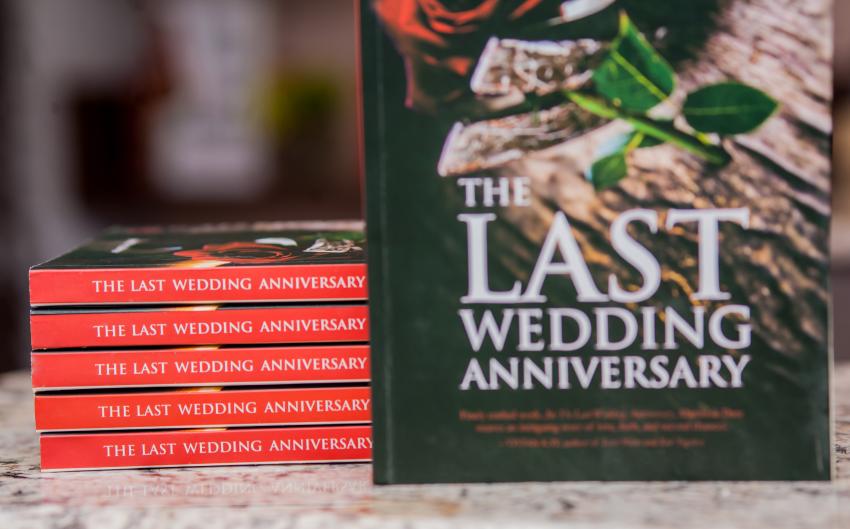
    In that end, the readers might be purged of their soaked-up emotions, fulfilling Aristotle’s centuries-old purgatory promise of literature. To read Abimbola Dare’s The Last Wedding Anniversary, published by Quramo Publishing, is to experience such rare literary-induced purgatory process.

    This is quite remarkable as Dare has taken on a commonplace human story about marriage, about love, that is threatening to keel over after its very foundational support, trust, is assailed by its expected antithesis, mistrust.

    A sudden sense of deja vu – have I not seen this before? – might not be an unexpected immediate feeling for a reader as they read the first few pages of the novel, which, in fact, might read like script for a domestic thriller.

    However, the story’s thrills lie in Dare’s graceful narrative facility shown in how she has weaved an unpretentiously complex plot around a woman whose hitherto secure trust in her God, her husband, her family, and herself will not secure her from her mind’s mistrust over her ability to become a mother, having repeatedly miscarries.

    The story central character, Celine’s internal conflict, which springs from those hurting miscarriages, frames the story-world external conflicts. Suddenly resorting to harrowing introspections, Celine becomes not only distrustful of her doting husband, but also goes so deep into the long closed recesses of her mind to haul out childhood hurts.

    The resultant primal trip back to her parents’ failed marriage becomes essentially an insidious measuring glass whose distorted images addle her perception of the state of her own marriage, and of her relationships with her sister, and everyone, and God.

    Suddenly, every act, mundane or extraordinary, is read in light of how her father had been a roguish jerk who betrayed her perfect mother.

    Reading every action and all object for their ominous signs of what to come, Celine will precipitously fall into her belief of betrayal by God who fails to replicate her own steadfastness; and by her husband who seems too unfazed to her state to not have been involved in some untoward affairs.

    Celine will thus become a prissy detector trailing her husband’s every move in their house, out of their house, to his work, to everywhere; and to her making her expected discovering: Biyi is what her father was; even more, Biyi is not cheating with his domestic maid as her father had, but with his sister-in-law!

    With the way the narration arcs up to that putatively climactic moment of discovery, what then unfurls the authentic reality of the tense situations in the world of the story will not but jolt the readers to the author’s mastery of narrative twist.

    The story’s twist brings to focus its sharp ironies, all more signposted by its title. The reader might learn in the story, however, that the last can truly become the first after a redemptive, but troubled journey.

    Meanwhile, the story’s plot recalls a cheetah’s blistering dash at its target that lasts few seconds as a cheetah cannot keep up with its own electrifying sprint for a long haul. The novel’s relatively few pages – 241 – are packed with jet-speed narratives that sometimes make reader grasp for water respite.

    More, the Bolt-speed is deployed for a criss-crossing narration that refuses to yield its ultimate secret until the novel’s last few pages. In those last resolving pages, there could seem the author might lose her controlling rein on her fictional creations, and so rushed to settle the conflicts of the story.

    However, none of the story’s parts seems out of sync from its plot whole.

    In fact, Dare’s greatest feat, in The Last Wedding Anniversary, could be said to be the way she has masterfully steered the course of its plots, when she could just have settled for an easy, tried and tested, escapist hurtle towards an otherwise anticipated story-end.

    *First published in Digirature.